skip to content
Current Lead Times: Rider-Ready Framesets: 3 weeks. Full Custom Bikes: 7 weeks.

Building Your Titanium and Carbon-Titanium Bikes in the USA for 28 Years

What Mountian Bike Magazine courtesy of bikeradar.com: Seven Cycles Sola 29 SLX Frame Review

by Justin LoretzShredding the trails

The most comfortable frame I’ve ever ridden and by default the most enjoyable too.

Quality like this doesn’t come cheap, though.

The Holy Grail, the Golden Fleece, the Ark of the Covenant, a basic understanding of the workings of the female mind – man’s search for each of these things is as fruitless as it is eternal. But one item, which until recently was on that very same list, has been found, at least according to What Mountain Bike’s Justin Loretz. He reckons his custom Seven Sola 29er is the most comfortable lightweight hardtail in the world. Here’s why…

The frame

My Sola 29 SLX was born in Watertown, Massachusetts, USA, in a small but perfectly formed workshop in Walnut Street. It’s the place where Seven Cycles reside and perform some pretty clever frame building magic.

When you order a custom frame, you need to know what you want. I love riding hardtails and I knew I wanted a lightweight frame designed for 29in wheels. However, I didn’t want a steep angled, ‘built to ride like a 26er’ bike or one that would jack-hammer my fragile spine to pulp (I’m 40 years old and have two blown/fused vertebrae in my lower back).

Why a 29er? I’ve raced and ridden 29ers side-by-side with scores of 26in wheeled bikes and hands down, a 29er goes uphill faster. I believe it’s down to the way torque is delivered to the rear contact patch, with the larger wheels smoothing out spikes in your power delivery and providing enhanced traction. As a result, you can get away with using a lighter and faster rolling ‘summer spec’ rear tyre all year round. For a cross-country speed demon, this is a win-win situation. Of course, if you’re convinced you want 26in wheels, Seven can do that too.

With help from the guys at Seven I quickly settled on the Sola 29 SLX as being the right base model for me. Light and lithe are the page tabs it’s filed under – perfect for my spinning, accurate and mildly aggressive riding style, but not so good for stiffness obsessed heavyweights. To nail the geometry I measured up a few bikes that I’d ridden and liked for different reasons, namely a Scott Scale 29er and Niner Air 9 Carbon, to boil down my measurements. The geometry had to deliver a ride that was both fast and stable. It had to be able to confidently chase full- suspension bikes down hills and through testing singletrack, and happily drift on loose fireroads.
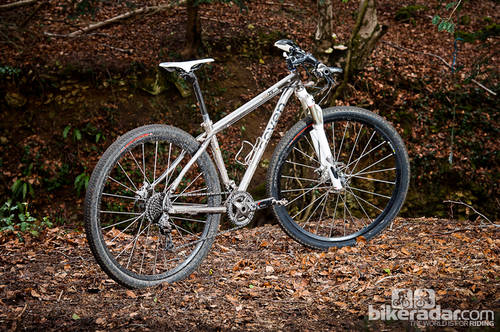
Seven Sola

In the end, I went for a 71.5° seat angle and 68.5° head angle – slack compared to the current trend for 29er front ends that are as steep as those on road bikes, but I prefer to give steering input from the saddle rather than having ‘shopping trolley’ steering at the handlebar. With the guys from Seven I double, triple and quadruple checked everything – never a bad thing to do before the ‘go’ button is pressed, especially on a frame as expensive as this. Undoing welds is nigh-on impossible, so it’s worth getting it right.

With the design nailed all I had to do was wait. And hope. And dream. And then wait a little longer. One thing is for sure – buying custom isn’t for the impatient. Bespoke ‘one bike at a time’ builders like Seven will take the time it requires to do their jobs and that could be a month or it could be three. However long it takes, they’ll keep you informed along the way. Eventually the Seven Cycles box will arrive on the back of the UPS truck and I defy anyone not to have an elevated heart rate and sweaty palms as they pop it open.

As soon as I laid eyes on the raw, unbuilt frame I knew I’d been sent exactly what I’d asked for. The only question that remained was whether its geometry was going to ride the way I predicted it would. I built it up with a 100mm-travel RockShox SID XX fork and SRAM X0/XX bits. Wheels are either Fulcrum XL29s, Bontrager RXL29s or ENVE Carbons depending on the ride/mood I’m in, and finishing kit is a work in progress, with Control Tech Ti Mania and Easton parts popping up, as well as an AX Lightness Daedalus seatpost.

Suffice to say the bike as built is sexy, surgical and sleek. The natural silver-grey sheen of titanium is extremely attractive. When it’s washed it’s like a surgeon’s blade, when it’s dirty it looks like it was made for mud. Dirt just makes it look more handsome – a bit like the rider!
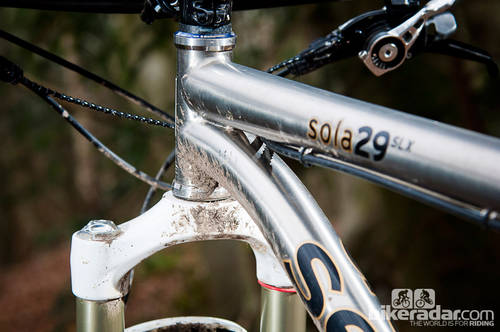
Sola 29 SLX

The ride

The ride, the ride… Oh if only I could plug you into my central nervous system. You’d see why I get home late, leave for work early and have an idiotic grin on my chops the entire day. Seven use their lightest Cirrus MTB titanium tubing on the SLX and the way it transmits vibration from the ground to your brain is like nothing else I’ve ever ridden, and I’ve ridden a lot of bikes in 20 years of testing. I was stunned to silence in 20 yards – that’s a new record for me.

The Seven has continued to leave me stunned in the three months and 800 miles we’ve been together. I’ve a mental Rolodex of how hundred of bikes have performed over my standard singletrack test loop. On the Seven, it takes a physical effort to wipe the smile off my face. I’m able to glide over terrain that normally makes hardtails feel hard and harsh, and in the big ring, spinning up what are normally horrible drag climbs I’m able to remain seated instead of resorting to the saddle-hover needed on most other hardtails.

As you turn the pedals you get the standard titanium frame feeling of having half-flat tyres, which takes a bit of getting used to. But there’s more. Seven have created a hardtail frame that feels more like a full-suspension one. When you hit bumps, the frame only transmits what feels like half the impact. It’s not just the rear end that soaks up the hits, either – the front end feels like it stretches a fraction and the whole chassis feels moulded to the ground.

Asked by other riders what the Seven feels like to ride I’ve found myself using terms like alive, dynamic, forgiving, even smooth and plush – two words normally reserved for full-suspension bikes. It doesn’t hurt that it weighs 21lb – a great weight for a 29er, which enables big ring, full gas riding whenever you feel like laying it down. On group rides my buddies now know that if I show up on the Seven they’re in for hurt.
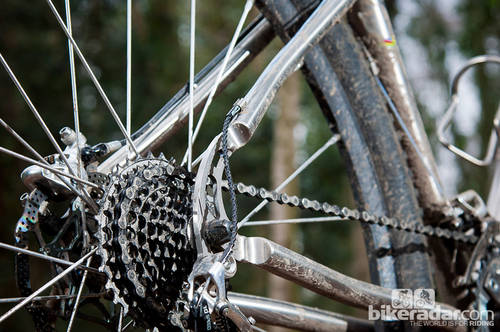
rear triangle

In fact, the only one who’s not getting hurt is me. The comfort of the thin titanium tubes means I can indulge in rides where the time spent riding is the time I have available, not the time I can physically endure. I think comfort as a target for bike manufacturers has long been overlooked. Sure it isn’t as sexy a sell as ‘the stiffest’ but if you can’t bear to sit on the thing after a few hours, what’s the point? Over the course of a long ride it can add up to leave you fresher and more able to belt out the watts when other riders are beaten.

The trade-off is in chassis stiffness. To make a titanium frame that’ll build into a 20lb bike with a focus on comfort, you have to be prepared to give away something. Some would undoubtedly find this specific Sola SLX too soft, but for me it’s as stiff as it needs to be. Hammering it, it doesn’t ghost shift, there’s no brake rub and the frame doesn’t feel mushy. I’d say it’s 95 percent accurate at cross-country speeds.

That percentage would be higher if it had a tapered-steerer-compatible head tube and oversize bottom bracket (since delivery, Seven have begun offering BB30 as an option). But if it had those things, other details like the size and thickness of the main tubes would have to be adjusted and it would be heavier and maybe not as comfortable, getting away from the core reason for doing it this way. Besides, would I really notice the five percent increase in accuracy? Look at it this way: the Sola isn’t anyway near as stiff as my 2011 Niner Air 9 Carbon but it’s three, maybe four times as comfortable. Perfect for me.

I simply haven’t ridden a better bike for my kind of wide ranging cross-country/trail riding than the Seven Sola 29 SLX. A custom frame like this doesn’t come cheap and the top-end build pictured here would cost in excess of £6,000 – enough to buy two or three full-suspension trail bikes. But you can’t judge a bike like the Seven like that. It’s what one of my riding buddies described as the “wife bike” – the one you want to settle down with.
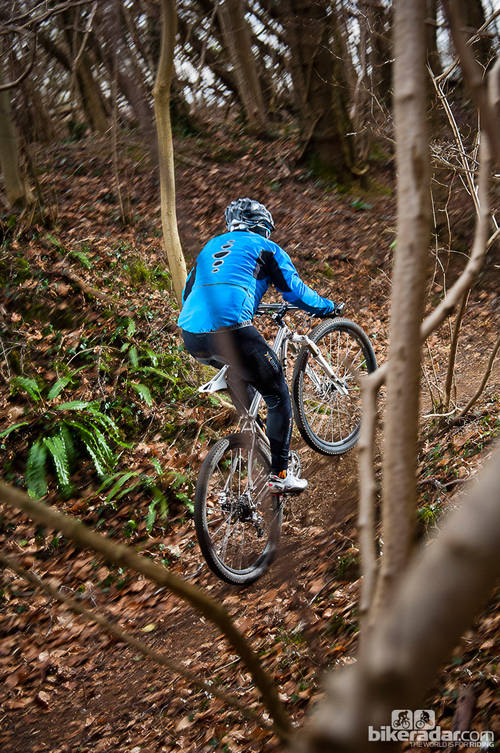
mountain bike climb

The Seven Cycles Showroom

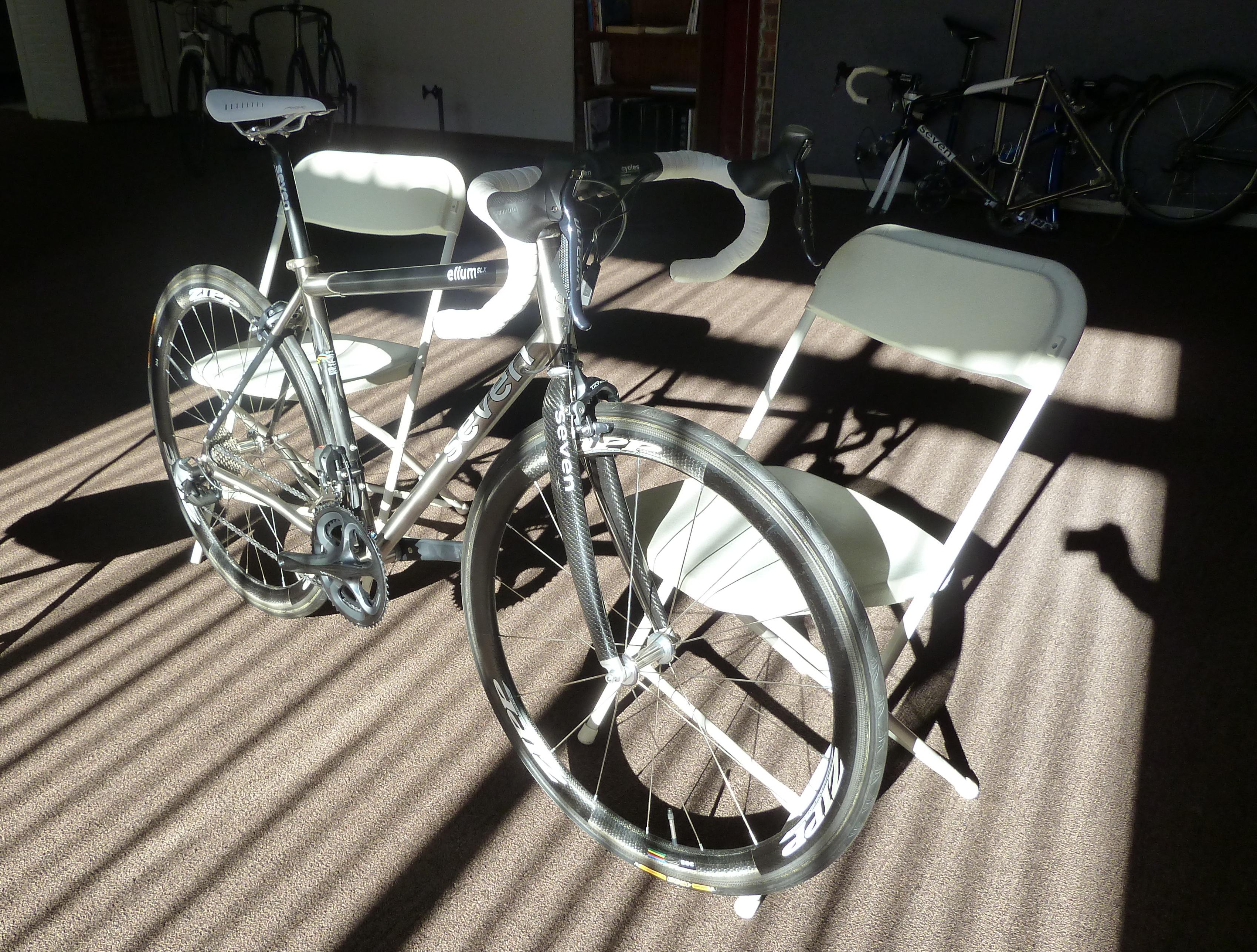
sunny showroom

Our showroom, such as it is, is a beautiful space, with vaulted ceilings and a generous supply of natural light. In the morning, the sun slants in through the blinds and bathes the few bikes that live there in a warm glow.

Invariably, we display our project bikes there. The Berlin Bike is often in residence. The Bicycling Magazine bike has been a frequent occupant. But, also invariably, those bikes want to go out to bike shops for display or for special events.

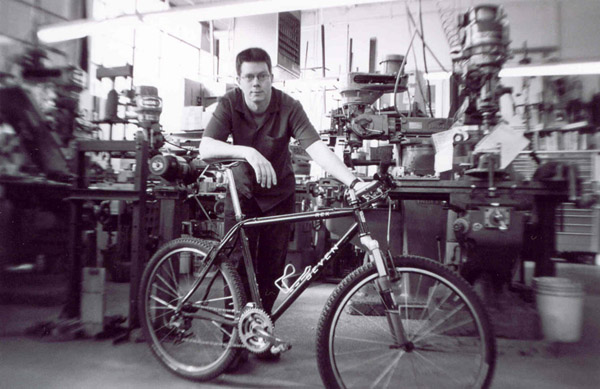
In the shop with a young Rob Vandermark leans on the first Seven bicycle ever made, a steel mountain bike

Today, just today, the bikes in the showroom consist of: Rex, the very first Seven, the primogenitor, the bike that spawned all others; Rob’s belt drive Cafe Racer with custom Tiberius handlebar and S&S frame couplers; Karl’s Elium SL, all carbon lightness in a pure-speed build.

We should make clear that employee bikes end up in the showroom quite a bit. Back at home, garages and storage rooms struggle to accommodate all of our cycling predilections. It ends up being a symbiotic arrangement. The showroom gets beautiful bikes to display. And our loyal Seven staff get more space for even more bikes.

There are a few frames hung in one corner, examples of our best custom paint work, and a pair of Elium SLXs with internally routed Di2 builds. They’re on their way out, demo bikes for shops who want the very latest in their own showrooms.

We joke a lot about the showroom. What do you call a bike company with no bikes? More than once, a passing tour has offered to buy an employee’s bike right off the display rack. It’s good to make a product you can’t keep in stock. It’s the problem you want to have.

Bike Radar: Pro bike – Mo Bruno-Roy’s Seven Mudhoney Pro

By Matt Pacocha, US editor, in Madison, WI

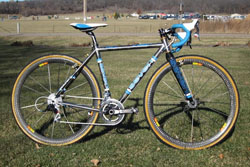
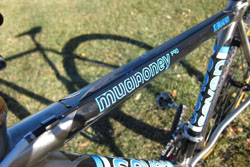
When Seven Cycles put Maureen Bruno-Roy (MM racing) on their new prototype carbon fiber and titanium cyclo-cross bike, the top tube said ‘Mohoney’ – a play on the name of their Mudhoney ‘cross line. The Mohoney has since turned into the Mudhoney Pro, which will be a production bike in 2012.

The new bike, which was released as a prototype in October, incorporates additional carbon tubes into its design, when compared to the Mudhoney SLX bikes that Bruno-Roy has ridden for the past four seasons – not just the same model mind you, but the same exact frames.

While the SLX has carbon top and seat tubes, the Pro trades out its titanium seatstays, head and down tubes for carbon as well, in an effort to lighten the frame and further dampen the vibrations that reach the rider, while retaining the terrain hugging suppleness and feel of titanium.

Bruno-Roy’s Mohoney race rig was the first ’cross bike Seven assembled with carbon rear stays, which are an adaptation from the company’s Elium SLX and 622SLX road bikes. “This rear triangle was completely novel for them, in terms of ’cross,†Matt Roy, Bruno-Roy’s husband, team manager and mechanic, told BikeRadar. “So this was the first one and it became the basis for the new Mudhoney Pro.â€

Rob Vandermark, Seven’s founder, laser-cut all of the titanium lugs for the Mohoney frame by hand. On the SLX these lugs are structural but on the Mudhoney they’re there purely for aesthetic reasons, as the carbon tubes are mitered and bonded to each other. The new bike is roughly 1lb lighter than Bruno-Roy’s SLX rigs. “I don’t think they expected it to be that much lighter,” said Roy.

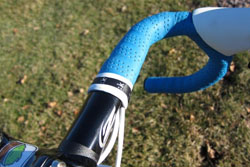
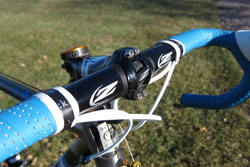
Bruno-Roy’s Mudhoney Pro gets the SRAM treatment, in terms of groupset and accompanying kit – Red with a compact crank and 44-tooth Thorne Components outer ring, and Zipp’s Service Course alloy cockpit. The handlebar is Zipp’s new Service Course CSL, which is made especially for smaller handed riders and has a ‘super-short reach’ and two-degree outward bend in the drops.

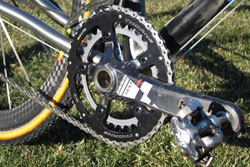
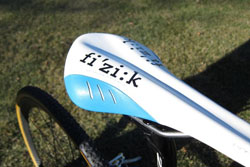
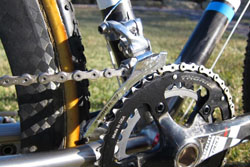
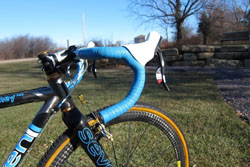
A compact gxp crank with 34-tooth sram inner ring and 44-tooth thorne outer ring: a compact gxp crank with 34-tooth sram inner ring and 44-tooth thorne outer ring Mo uses a 44-tooth outer ring. Since SRAM only make a 46t ring, she opts for one from Stu Thorne’s Thorne Products. Also note the ‘late model’ Shimano PD-M970 pedals, which remain more popular on the cyclo-cross circuit than the M980 model due to their better mud performance Deviations from the SRAM brand come in the form of Bruno-Roy’s TRP EuroX Mag brakes and Mavic wheel choices. She has both Cosmic Carbone Ultimate and R-SYS SL tubular models. The former are mostly used with Challenge Grifos (with both standard Challenge and FMB casings), whereas the R-SYS are set for mud with Challenge Limus and FMB Super Mud tires. Roy takes a meticulous approach to the upkeep of his wife’s bikes and it shows through in the finished product. When we saw the bike the day before the USA Cycling cyclo-cross nationals in Madison, Wisconsin it sparkled and gleamed, with touches like fully sealed and shrink wrapped cables, custom stickers on the Fi’zi:k TK saddle and an expertly taped handlebar.

Complete bike specification

  • Frame: Seven Mudhoney Pro prototype
  • Fork: Seven CX
  • Headset: Chris King NoThreadset, 1-1/8in
  • Stem: Zipp Service Course SL, 80mm, -6°
  • Handlebar: Zipp Service Course CSL, 40cm
  • Tape: Fi:zi’k Microtex Bar:tape
  • Front brake: TRP EuroX Mag w/ SwissStop Yellow King pads for Mavic wheels
  • Rear brake: TRP EuroX Mag w/ SwissStop Yellow King pads for Mavic wheels
  • Front derailleur: SRAM Red w/steel cage
  • Rear derailleur: SRAM Black Red
  • Shifter: SRAM Black Red
  • Brake levers: SRAM Black Red
  • Cassette: SRAM PG1070, 12-28t
  • Chain: SRAM PC1091
  • Crankset: SRAM Black Red Compact, 170mm, 44/34t
  • Bottom bracket: SRAM Red GXP ceramic
  • Pedals: Shimano XTR PD-M970
  • Wheelset: Mavic Cosmic Carbone Ultimate (or R-SYS SL w/ mud tires)
  • Front tire: Challenge Grifo, 17-21psi, Aquaseal coating
  • Rear tire: Challenge Grifo, 17-21psi, Aquaseal coating
  • Saddle: Fi:zi’k Aliante Donna K:ium
  • Seatpost: Zipp Service Course SL

Critical rider measurements

  • Rider’s height: 161.9cm/5ft 4in
  • Rider’s weight: 48.08kg/106lb
  • Saddle height from BB, c-t: 66.4cm
  • Saddle setback: 1.8cm
  • Seat tube length, c-t: 50cm
  • Tip of saddle to center of bar: 46.5cm
  • Saddle to bar drop: 2.9cm
  • Head tube length: 9cm
  • Top tube length (virtual): 49.5cm
  • Total bicycle weight: 7.4kg/16.33lb

Gallery Images

Mudhoney PRO
Maureen Bruno-Roy’s Seven Mudhoney Pro prototype
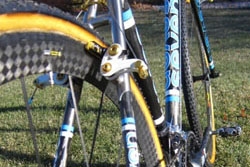
brakes
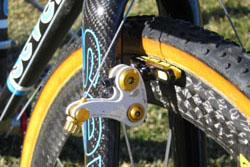
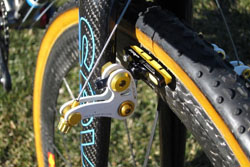
Bruno-Roy sticks with TRP’s old-school EuroX Mag wide-profile brake
front end
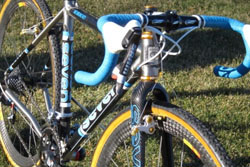
Bruno-Roy’s Mudhoney Pro carried her to a top 10 finish at the 2012 USA Cycling national championships
brakes
SwissStop Yellow King pads for the TRP EuroX brakes
crankset
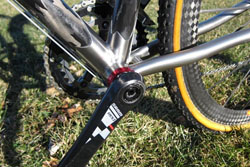
A compact GXP crank with 34-tooth SRAM inner ring and 44-tooth Thorne outer ring
pedals
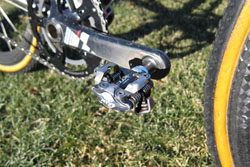
Shimano’s stalwart XTR M970 pedal
seat post
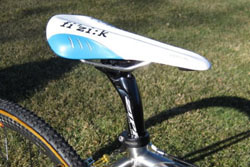
Fi’zi:k’s Arione Donna women’s saddle
saddle
Matt Roy hand placed the Fi’zi:k logos
headset
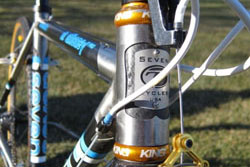
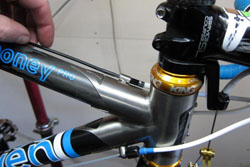
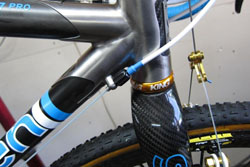
The Mudhoney Pro uses a carbon head tube that’s wrapped in titanium. Mo’s is just 90mm tall
down tube
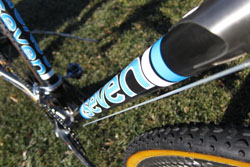
The Mudhoney Pro also employs a carbon down tube…
seat tube
… and a carbon seat tube
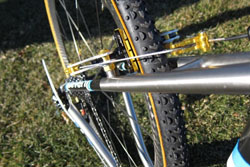
rear end
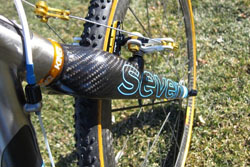
The mixed carbon-Ti seatstays
rear brakes
The Ti sheaths extend so to hold the brake bosses
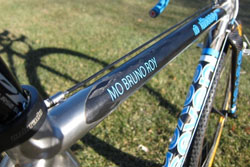
top tube
Mo’s bike
sticker
Inspiration from the mechanic – that’s an alien with a ray gun
front derailleur
The steel caged SRAM Red front derailleur
fork
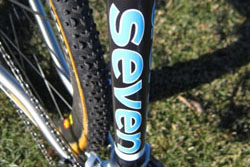
Seven’s carbon CX fork
tire
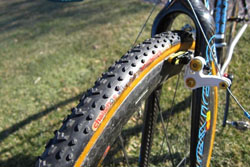
Roy uses Aquaseal on the sidewalls of Challenge’s Grifo
top tube
The Mohoney turned into the Mudhoney Pro
handlebar tape
An expert tape job with a custom finish
stem
Zipp’s Service Course cockpit
brake lever
The Service Course CSL bar has a compact bend with a super-short reach
bottom bracket
The Red GXP ceramic bottom bracket
front derailleur shim
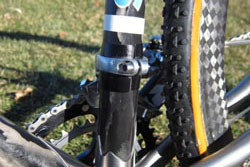
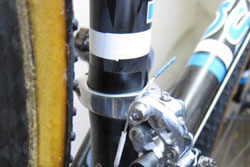
Roy finds that clamp-style front derailleurs are stiffer and shift better; Seven use a set of shims to more evenly distribute the clamping load on the carbon seat tube
sizing up
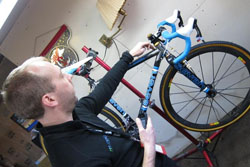
Mechanic Matt Roy running us through Mo’s bike
lug
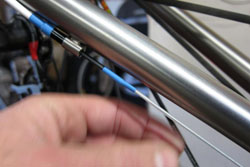
Custom sealed cables
barrel cable adjuster
Roy uses shrink tubing found at electronics stores to seal the cable system
rear derailleur
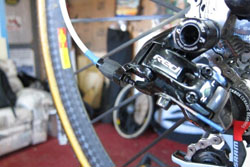
He even seals the cable as it exits to the rear derailleur anchor bolt
details
More custom sealing
details
Seals on the front derailleur; Roy also uses the shrink wrap as a cable end cap

Bicycling: Dream Bikes – Rides Like a Dream

Joe Lindsey

Axiom SL: Traditional Ti with Unmatched HeritageAxiom SL

Since opening in 1997, Massachusetts-based Seven Cycles has produced everything from belt-drive commuters to carbon-fiber time-trial bikes. But Seven’s beating heart has always been custom titanium, a legacy of founder Rob Vandermark’s long tenure at one-time industry leader Merlin Metalworks. When he left, he took his vision and expertise (not to mention several employees). If you want a Merlin today, you buy a Seven. The Axiom SL, Seven’s most traditional and versatile frame, is a study in the company’s philosophy: Fit and ride quality are paramount, while character and performance are almost infinitely malleable. A dream bike is not just a machine: it’s a deeply personal expression of a rider’s self, entrusted to master craftsmen to interpret and make real. We do not choose lightly whom to entrust with those dreams; with our test Axiom SL, as with thousands of frames before it, Seven has earned that trust.

The Axiom is not going to be mistaken for a top-drawer carbon race bike. It flexes, but in doing so shows it’s alive. Seven can tune even more stiffness into the bike, but I wanted a more balanced ride. This bike proves that you don’t need carbon for performance. Like other custom shops, Seven can build in a BB30 bottom bracket, but this bike is wonderfully reverent, with a traditional 68mm BB shell and a straight 1 1/8-inch steerer tube with a standard King headset. Though the bike isn’t the lightest, at 16.04 pounds for a 54cm, it climbs as well as, or better than, bikes that weight much less.

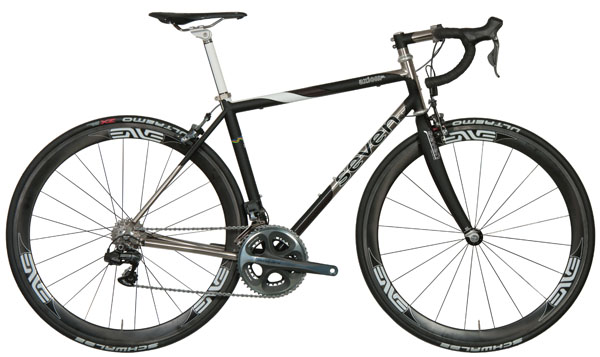
This Axiom uses a very neat Di2 setup, with just three holes in the frame—near the head tube for the wiring harness, and at the seat tube and chainstay for each of the derailleur wires. The battery is housed in the seat post, which gives the bike a clean and stealthy look. Should you ever decide to go back to mechanical, you could get cable stops on the frame even after the fact.

boston.com: Make a Holiday Wish

By Luke O’Neil

We ask local celebrities and people of influence what gift(s) they want

SEAN GRIFFING, co-owner of Trade

Odonata

A Seven Cycles 622 SLX road bike (www.sevencycles.com). I’m an avid cyclist. This bike is new for the 2012 model year for Seven and it is their lightest production frame to date. Each Seven bicycle is custom made in Watertown for the rider’s specific body type and riding style. It’s a beautiful marriage of carbon and titanium. Or an Evoluzione Range espresso machine from Rocket Espresso is the Ferrari of espresso machines and would be a perfect addition to my home kitchen.